Aliphatic vs. Aromatic TPU: Why the Chemistry of Your PPF Matters for Long-Term Profits
As a wholesale distributor of Paint Protection Film (PPF), you evaluate many product specifications: thickness, gloss, self‑healing capability, and price per square meter. But there is one fundamental chemical choice hidden inside every roll that silently determines nearly every aspect of long‑term performance – and ultimately, your profitability.
That choice is aliphatic TPU vs. aromatic TPU.
While both are types of thermoplastic polyurethane, their molecular structures lead to dramatically different real‑world outcomes. Understanding this difference will forever change how you select PPF for your inventory.
The Basics: What Is TPU?
TPU (thermoplastic polyurethane) is the base material of every premium PPF. It provides the film’s strength, flexibility, impact resistance, and optical clarity. The “polyurethane” family offers immense versatility because its properties can be tuned by choosing different building blocks – specifically, different types of diisocyanates.
The two main families of diisocyanates used in PPF manufacturing are:
-
Aromatic diisocyanates (e.g., MDI – methylene diphenyl diisocyanate)
-
Aliphatic diisocyanates (e.g., HDI – hexamethylene diisocyanate, IPDI – isophorone diisocyanate)
That one choice changes everything.

Aromatic TPU: The Low‑Cost Compromise
Aromatic TPU is cheaper to produce. It offers good tensile strength and abrasion resistance, which is why it is still used in many economy‑grade PPFs, industrial films, and protective covers.

But aromatic TPU has a fatal flaw for automotive use:
Its molecular structure contains benzene rings. These benzene rings absorb energy and undergo oxidation under ultraviolet light, generating chromophores, which causes the film to yellow rapidly.
The consequences of aromatic TPU:
| Issue | Real‑World Impact |
|---|---|
| Rapid yellowing | Within 6–18 months, the film develops an obvious amber or yellow tint. On white or light‑colored cars, it looks terrible. |
| Brittleness over time | UV exposure also breaks polymer chains, causing the film to lose flexibility and crack – especially on curved panels. |
| Poor clarity retention | Even before visible yellowing, optical clarity degrades, making the paint look dull. |
| Short usable life | Aromatic PPF rarely lasts beyond 2–3 years without looking aged. Some warranties are short, or exclude UV damage. |
For your wholesale customers: Aromatic PPF leads to angry end‑users, warranty claims, and lost repeat business. The “savings” per roll vanish when you account for removal, reinstallation, and reputation damage.
Aliphatic TPU: The Premium, Long‑Term Solution
Aliphatic TPU is manufactured using diisocyanates that contain no benzene rings. Instead, the molecular structure is based on saturated carbon chains (e.g., hexamethylene). This simple change has profound effects.
Why aliphatic TPU outperforms:
| Property | Aliphatic TPU Advantage |
|---|---|
| UV resistance | No benzene rings means no UV‑induced yellowing. Clear stays clear for 5–10+ years. |
| Flexibility retention | Polymer chains resist cross‑linking from UV, maintaining original stretch and conformability. |
| Gloss and clarity | Optical properties remain stable over the life of the film. |
| Long warranty potential | Manufacturers confidently offer 7‑ or 10‑year warranties against yellowing and cracking. |
Aliphatic TPU is more expensive to produce, and that higher raw material cost is reflected in the wholesale price. But – and this is crucial – the total cost of ownership over the film’s life is often lower because:
-
Fewer warranty claims
-
Higher customer satisfaction → repeat and referral business
-
Ability to command premium pricing
Side‑by‑Side Comparison: Aromatic vs. Aliphatic TPU

| Feature | Aromatic TPU | Aliphatic TPU |
|---|---|---|
| Chemical structure | Contains benzene rings | No benzene rings (saturated chains) |
| Initial cost | Low | Medium to high |
| UV/yellowing resistance | Poor – yellows in 6–18 months | Excellent – 5–10+ years clear |
| Flexibility over time | Becomes brittle | Remains flexible |
| Clarity retention | Degrades quickly | Stable for years |
| Typical warranty | 1–3 years (often excludes UV) | 5–10 years (includes yellowing) |
| Best use case | Temporary protection, industrial | Automotive PPF, long‑term protection |
| Resale value impact | Negative – film looks old | Positive – preserves original paint |
How This Chemical Choice Affects Your Wholesale Profits
As a distributor, you might be tempted to stock cheaper aromatic‑based PPF to offer a lower price point. That strategy almost always backfires.

The math of false economy:
Assume you sell two similar rolls of PPF:
| Aromatic PPF | Aliphatic PPF (ELOV) | |
|---|---|---|
| Wholesale price per roll | $200 | $350 |
| Installer retail price | $500 | $800 |
| Installer profit per job | $300 | $450 |
| Customer satisfaction | Low after 1 year | High for 5+ years |
| Warranty claims (est.) | 20% of rolls | <1% of rolls |
| Repeat purchase rate | Low | High |
The hidden costs of aromatic PPF:
-
Replacement labor – Removing yellowed, cracked film costs the installer time and money. They will blame the film – and you.
-
Refunds and returns – You will eat the cost of defective rolls.
-
Reputation erosion – One angry customer tells 10 others. Your brand becomes associated with “cheap film that fails.”
Aliphatic PPF, on the other hand, builds trust. Installers who use it know their work will look great for years. They will reorder from you, not search for a cheaper alternative.
How to Verify That You Are Getting True Aliphatic TPU
Not every film labeled “aliphatic” is created equal. Some suppliers blend aromatic and aliphatic components or use low-grade aliphatic chains. Here is how to protect yourself:
-
Request a technical data sheet (TDS) that specifies the base polymer chemistry.
-
Ask for QUV accelerated weathering test results – Look for ΔE (color change) below 2.0 after 1000+ hours.
-
Perform your own simple test – Expose a sample to intense sunlight (or a UV lamp) for 2–4 weeks. Aromatic film will yellow noticeably; aliphatic will not.
-
Check warranty language – Does the warranty explicitly cover “yellowing” for 5+ years? If not, suspect aromatic.

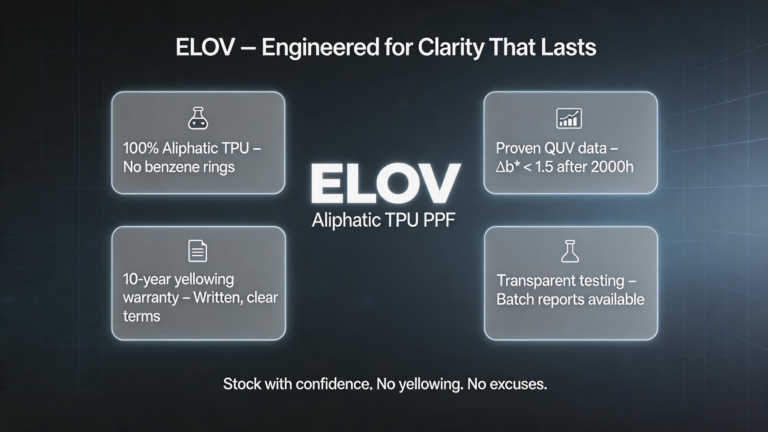
ELOV provides full transparency: every roll we ship is 100% aliphatic TPU, backed by published QUV data and a 10‑year warranty against yellowing.
The Bottom Line: Chemistry Is Not a Marketing Gimmick
When your installer customers ask, “Why is your film more expensive than the cheap stuff on AliExpress?” you can answer with confidence: Because our film uses aliphatic TPU. It will not yellow, crack, or disappoint your clients after one summer.
Selling aliphatic‑based PPF is not about charging more – it is about delivering more value. Your customers will stay loyal because their customers stay happy.
Ready to Stock Premium Aliphatic PPF?
ELOV manufactures and supplies 100% aliphatic TPU paint protection film in clear, matte, satin, and full color options. We offer:
-
Factory‑direct wholesale pricing
-
Low MOQs for trial orders
-
Private label (OEM) programs
-
QUV test data and full technical documentation
-
10‑year warranty against yellowing
Contact ELOV today to request sample rolls, compare side‑by‑side with any aromatic film, and see the difference chemistry makes.