The Truth About PPF Yellowing: What Causes It and How to Choose Film That Stays Clear
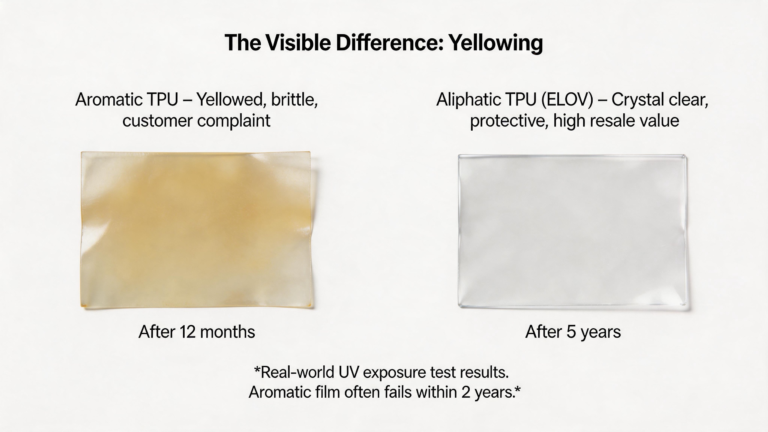
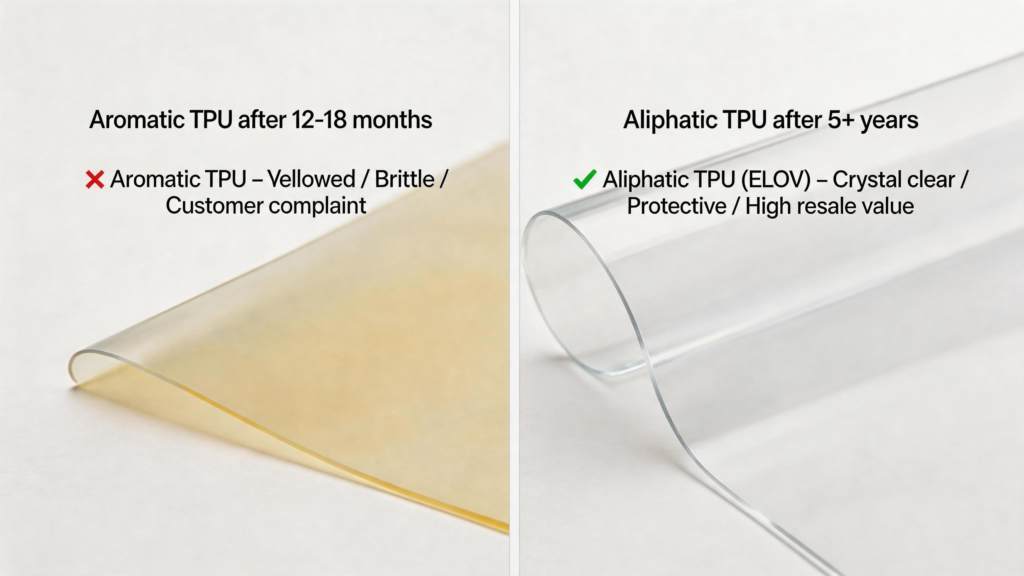
Few things damage a PPF installer’s reputation faster than a car that returns after 12 months with a yellow, hazy, or bronze‑tinted front end. The customer paid good money for “invisible protection,” but what they see is an ugly discoloration that makes their expensive car look old and neglected.
As a wholesale distributor, you are caught in the middle. Your installer customer blames the film. The end customer blames the installer. And you are left processing warranty claims, shipping replacement rolls, and losing trust.
But yellowing is not a mystery. It is a well‑understood chemical process. And once you understand what causes it, you can choose – and recommend – films that stay crystal clear for years. This article explains the science behind PPF yellowing, separates fact from fiction, and gives you a simple checklist for sourcing film that resists yellowing.
What Is PPF Yellowing – And Why Does It Matter?
PPF yellowing is a visible change in the film’s color, typically shifting from water‑clear to a yellowish, amber, or brownish tint. It usually starts subtly – barely noticeable – then becomes more obvious over time. On white, silver, or light‑colored cars, yellowing is immediately obvious and unacceptable to customers.
Why it matters to your business:
-
Warranty claims – Costly and time‑consuming.
-
Installer defection – Shops that experience yellowing will switch suppliers.
-
Reputation damage – Yellowing film becomes a public advertisement for poor quality.
-
Lost resale value – A yellowed film makes a car look poorly maintained, hurting the owner’s ability to sell.
The best way to avoid these problems is to understand the cause – and to stop believing common myths about yellowing.
The Root Cause of Yellowing: Chemistry, Not Age
Most people assume that all PPF will eventually yellow – that it is simply a matter of time. That is false.
Yellowing is not inevitable. It is a direct result of chemical instability in the film’s base polymer or top coat.
The Culprit: Aromatic TPU
TPU (thermoplastic polyurethane) is the base material of almost all PPF. But TPU comes in two chemical families:
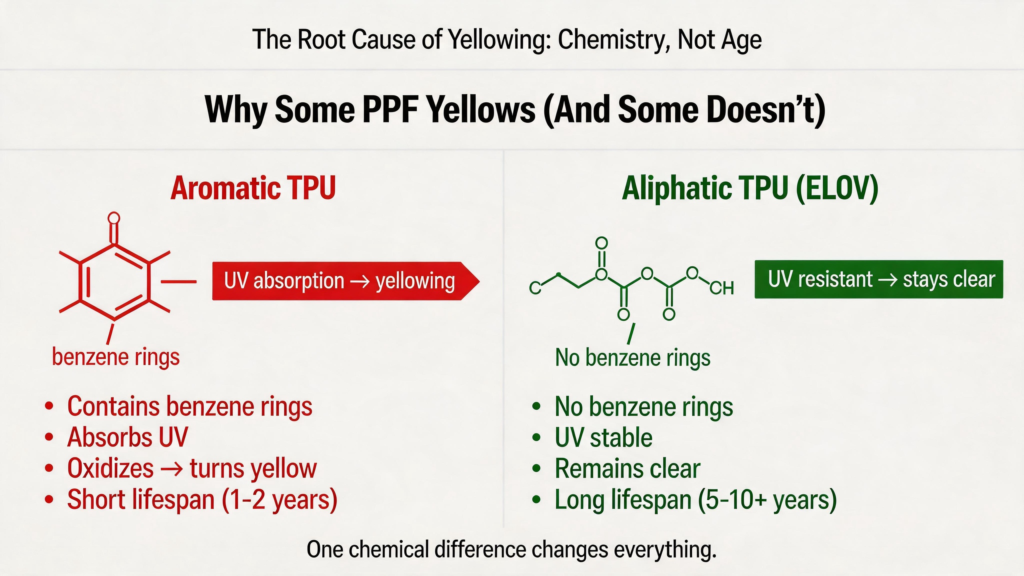
| TPU Type | Chemical Structure | UV Resistance | Yellowing Risk |
|---|---|---|---|
| Aromatic TPU | Contains benzene rings | Poor – absorbs UV and oxidizes | High – yellows within months to 2 years |
| Aliphatic TPU | No benzene rings (saturated chains) | Excellent – resists UV degradation | Near zero – stays clear for 5–10+ years |
Why aromatic TPU yellows: The benzene rings in aromatic TPU absorb ultraviolet energy. That energy breaks chemical bonds and creates new “chromophores” – colored molecular fragments that scatter light in the yellow/amber spectrum. Once formed, these chromophores are permanent.
Why aliphatic TPU stays clear: Aliphatic TPU contains no benzene rings. It does not absorb UV in a way that creates chromophores. The polymer remains chemically stable, so the film stays optically clear.
Other Contributing Factors
-
Poor‑quality top coat – Even aliphatic TPU can yellow if the top coat lacks adequate UV absorbers or HALS (hindered amine light stabilizers).
-
Contamination during manufacturing – Residual solvents or catalysts can cause yellowing over time.
-
Heat exposure – Extreme heat can accelerate oxidation in marginal materials, but heat alone does not cause yellowing in true aliphatic TPU.
Common Myths About Yellowing – Busted
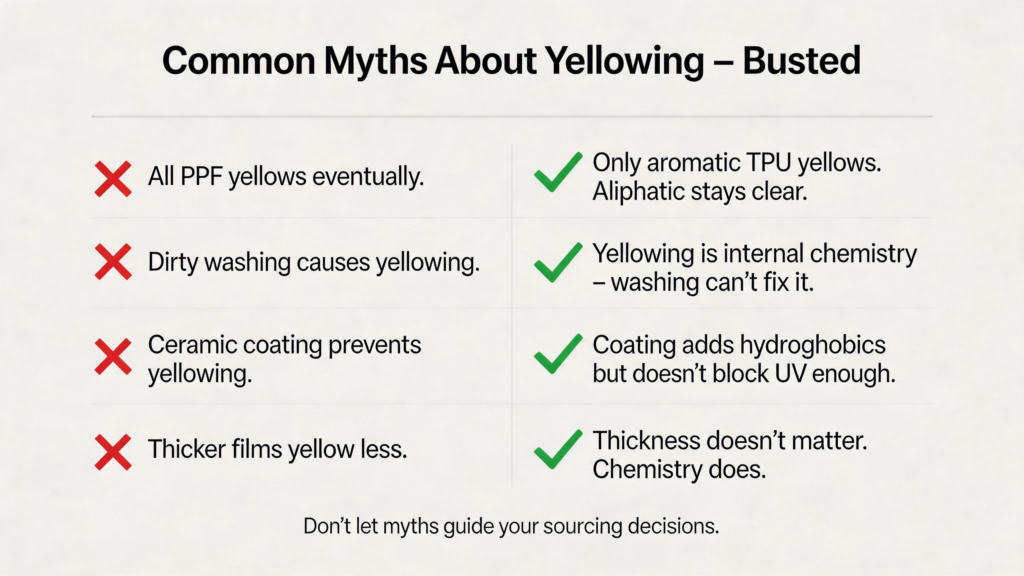
Myth #1: “All PPF yellows eventually. It’s normal.”
False. Premium aliphatic TPU films (like ELOV) show no visible yellowing after 5–7 years of real‑world exposure. The idea that yellowing is inevitable comes from years of cheap aromatic films setting a low standard.
Myth #2: “Yellowing is caused by dirt or improper washing.”
False. While dirt can make a film look dull, true chemical yellowing is internal – it comes from the material itself. No amount of washing can remove it.
Myth #3: “Ceramic coating prevents yellowing.”
False. A ceramic coating adds a hydrophobic layer on top, but it does not block UV sufficiently to prevent yellowing of an unstable TPU underneath. You cannot “fix” an aromatic film with a coating.
Myth #4: “Thicker films yellow less.”
False. Thickness has no relationship to chemical stability. A 10‑mil aromatic film will yellow just as fast as a 6‑mil aromatic film. Only the chemistry matters.
How to Choose PPF That Stays Clear – A Wholesaler’s Checklist
When evaluating suppliers or stocking inventory, use this checklist to ensure you are buying film that resists yellowing.
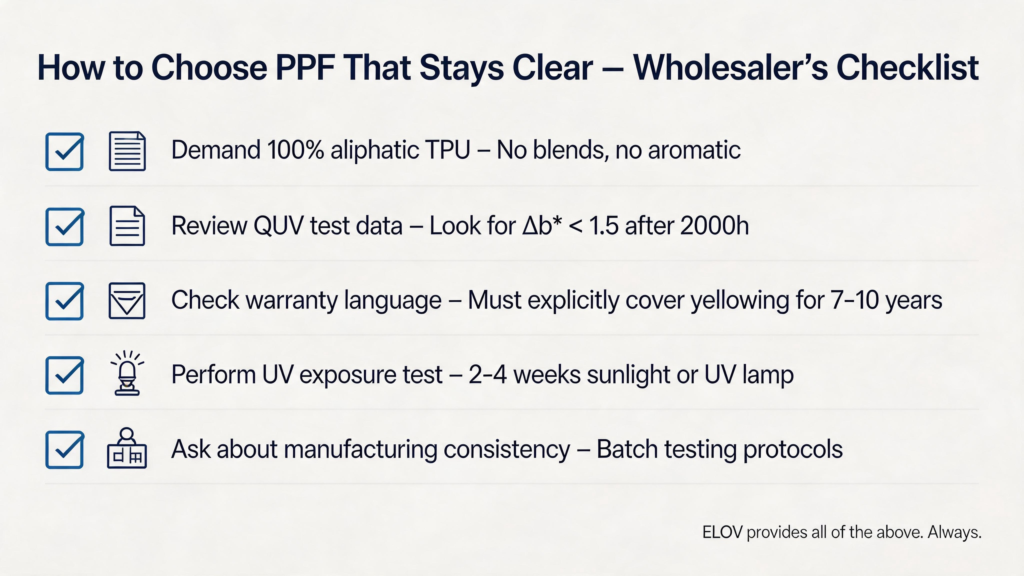
✅ 1. Demand 100% Aliphatic TPU
Do not accept “aliphatic blend” or “high‑grade TPU.” Ask for written confirmation that the base polymer is aliphatic (fatty) TPU, not aromatic. Reputable suppliers will provide this on their technical data sheet (TDS).
✅ 2. Review QUV Accelerated Weathering Data
QUV testing simulates years of UV exposure. Look for:
| Test Parameter | Good Result | Excellent Result |
|---|---|---|
| Yellowing (ΔE / Δb*) | ΔE < 3.0 after 1000h | Δb* < 1.5 after 2000h |
| Gloss retention | >85% after 1000h | >90% after 2000h |
| Test standard | ASTM G154, SAE J2527 | Same |
Ask for test reports from an independent lab or the factory’s own quality department. If they cannot provide QUV data, walk away.
✅ 3. Check the Warranty Language
A warranty that excludes “yellowing” or only covers “defects in materials” is a red flag. Premium aliphatic PPF comes with a written warranty against yellowing – typically 7 or 10 years.
Read the fine print: Does the warranty cover yellowing? For how long? Are there exclusions (e.g., “extreme conditions”)? The best warranties are simple and explicit.
✅ 4. Perform a Simple UV Exposure Test
Before committing to a large order, take a sample and place it in direct sunlight (or under a UV lamp) for 2–4 weeks. Compare it to an unexposed sample. Aromatic film will show visible yellowing. Aliphatic film will not.
You can also use a UV‑C lamp (short wavelength) to accelerate the test – but sunlight is the most realistic.
✅ 5. Ask About the Manufacturing Process
How does the factory ensure batch‑to‑batch consistency? Do they test each batch for UV stability? Suppliers who take quality seriously will be happy to discuss their processes.
What About Top Coat Yellowing?
Even with aliphatic TPU, the top coat can yellow if it is formulated with poor‑grade UV absorbers. The best top coats use:
-
High‑concentration UV absorbers (benzotriazoles or triazines)
-
HALS (hindered amine light stabilizers) to scavenge free radicals
-
No cheap plasticizers that can migrate and yellow
ELOV’s top coat is engineered specifically for long‑term UV stability. Our QUV testing shows Δb < 1.5 after 2000 hours* – well below the threshold of visible yellowing.
What to Tell Your Installer Customers
When you sell ELOV PPF, you can confidently answer their questions about yellowing:
-
“Why does my cheap film keep yellowing?” – Because it uses aromatic TPU. That is the real difference.
-
“How long will ELOV stay clear?” – Our 10‑year warranty against yellowing is backed by QUV test data. Expect 5–7+ years of visible clarity in normal use.
-
“Can I put ceramic coating on top?” – Yes, it will not hurt, but it is not needed to prevent yellowing.
-
“What about the edges – do they yellow first?” – No. True aliphatic TPU yellows uniformly if at all. Edge yellowing is usually dirt or adhesive failure, not the film itself.
The Bottom Line: Yellowing Is a Choice
Not all PPF yellows. The belief that it is inevitable is a myth propagated by cheap, aromatic‑based films. By choosing 100% aliphatic TPU from a supplier who provides transparent test data and a real yellowing warranty, you eliminate yellowing from your list of worries.
As a wholesale distributor, you have a choice: sell film that will fail and generate claims, or sell film that builds trust and repeat business.
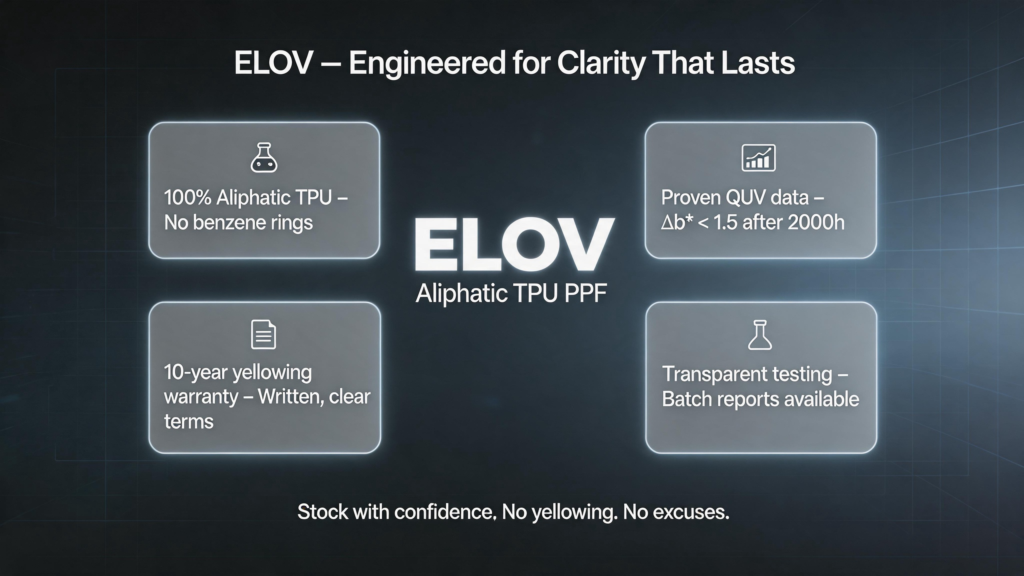
ELOV makes the right choice easy. Every roll of ELOV PPF – clear, matte, or color – is 100% aliphatic TPU with a self‑healing top coat and a 10‑year warranty against yellowing.
Ready to Stock PPF That Stays Clear?
Contact ELOV today to request:
-
QUV test reports (full data sheets)
-
Aliphatic TPU certification
-
Sample rolls for your own UV exposure test
-
Wholesale pricing and low‑MOQ trial orders